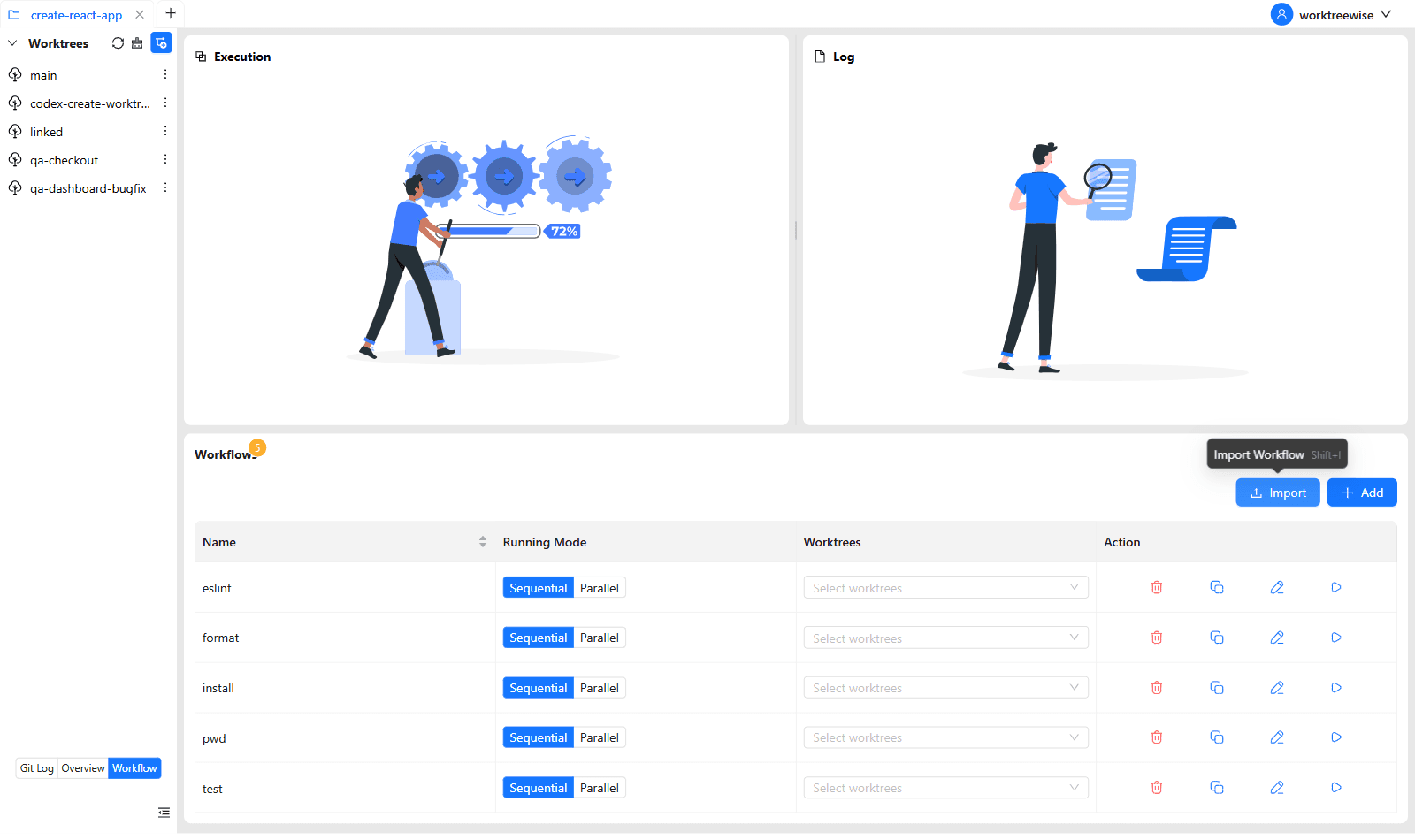
Import Workflows
WorktreeWise makes it simple to share and reuse automation routines across different projects and repositories. Rather than re-entering complex multi-step build, test, and deployment commands by hand, you can import workflow definitions directly from any existing repository.
How Workflow Storage Works
In WorktreeWise, workflows are stored locally within your repository’s Git administrative directory:
<repository-root>/
└── .git/
    └── WorktreeWise/
        ├── Build & Test/
        │   └── details.json
        └── Clean & Reset/
            └── details.json
Each workflow is defined as a structured JSON document (details.json) containing the workflow name, primary initial command, and subsequent sequential execution steps:
{
  "name": "Full CI Validation",
  "command": {
    "key": "0",
    "value": "pnpm install --frozen-lockfile"
  },
  "commands": [
    { "key": "1", "value": "pnpm lint" },
    { "key": "2", "value": "pnpm test:unit" },
    { "key": "3", "value": "pnpm build" }
  ]
}
When importing, WorktreeWise scans the target repository’s .git/WorktreeWise/ directory, extracts all definitions, and presents them in an interactive review modal before copying them into the active repository.
Step-by-Step Import Guide
Open the Import Dialog
Navigate to the Workflows tab in WorktreeWise and click the Import button in the top action bar. Alternatively, press the global shortcut:
- Shortcut:
Shift + I
Select the Source Repository
A native OS directory picker dialog will open. Navigate to and select the root directory of the repository or project that contains the workflow configurations you want to import.
Review Discovered Workflows
WorktreeWise reads the target .git/WorktreeWise directory and opens the Import Workflow review modal:
- Checkbox selection: Choose individual workflows or click the header checkbox to select all.
- Name column: Shows the original name of each discovered workflow.
- Command(s) column: Displays an ordered preview of every command that will run during execution.
Confirm and Import
Click Confirm. WorktreeWise validates the definitions and atomically copies them into the current repository’s .git/WorktreeWise/ directory.
Conflict Detection & Safety Rules
WorktreeWise implements strict validation to prevent accidental data loss:
| Condition | System Behavior |
|---|---|
| Name Collision | If an imported workflow shares the exact name of an existing workflow in the active repository, WorktreeWise aborts the import for that workflow with an explicit error: "A workflow with this name already exists." This guarantees your local workflows are never silently overwritten. |
| Permission Verification | If the local .git/ directory has restricted file system permissions (EACCES or EPERM), WorktreeWise displays an actionable alert instructing you to check directory ownership and write permissions. |
| Post-Import Editing | Imported workflows behave identically to native workflows. You can immediately edit command strings, reorder steps, duplicate them as templates, or delete them. |
Sharing Workflows Across Teams:
Because workflows are saved in .git/WorktreeWise/details.json, you can version-control workflow templates by checking them into a shared repository folder (such as .github/workflows-templates/ or tools/workflows/) and copying or symlinking them to .git/WorktreeWise/ during project bootstrapping.
Environment & Tooling Pre-requisites:
Imported workflows execute commands using your local shell configuration. Ensure that any required CLI binaries, package managers (npm, pnpm, yarn, cargo), or environment variables specified in imported commands are installed and accessible on your current machine.