Worktree Overview
The Worktree Overview provides a single cockpit for monitoring repository health, branch divergence, uncommitted changes, activity recency, and disk consumption across every linked worktree.
To access the Worktree Overview:
- Click Overview at the bottom of the Worktrees sidebar.
- Or press Shift + O while focused on the Worktrees view.
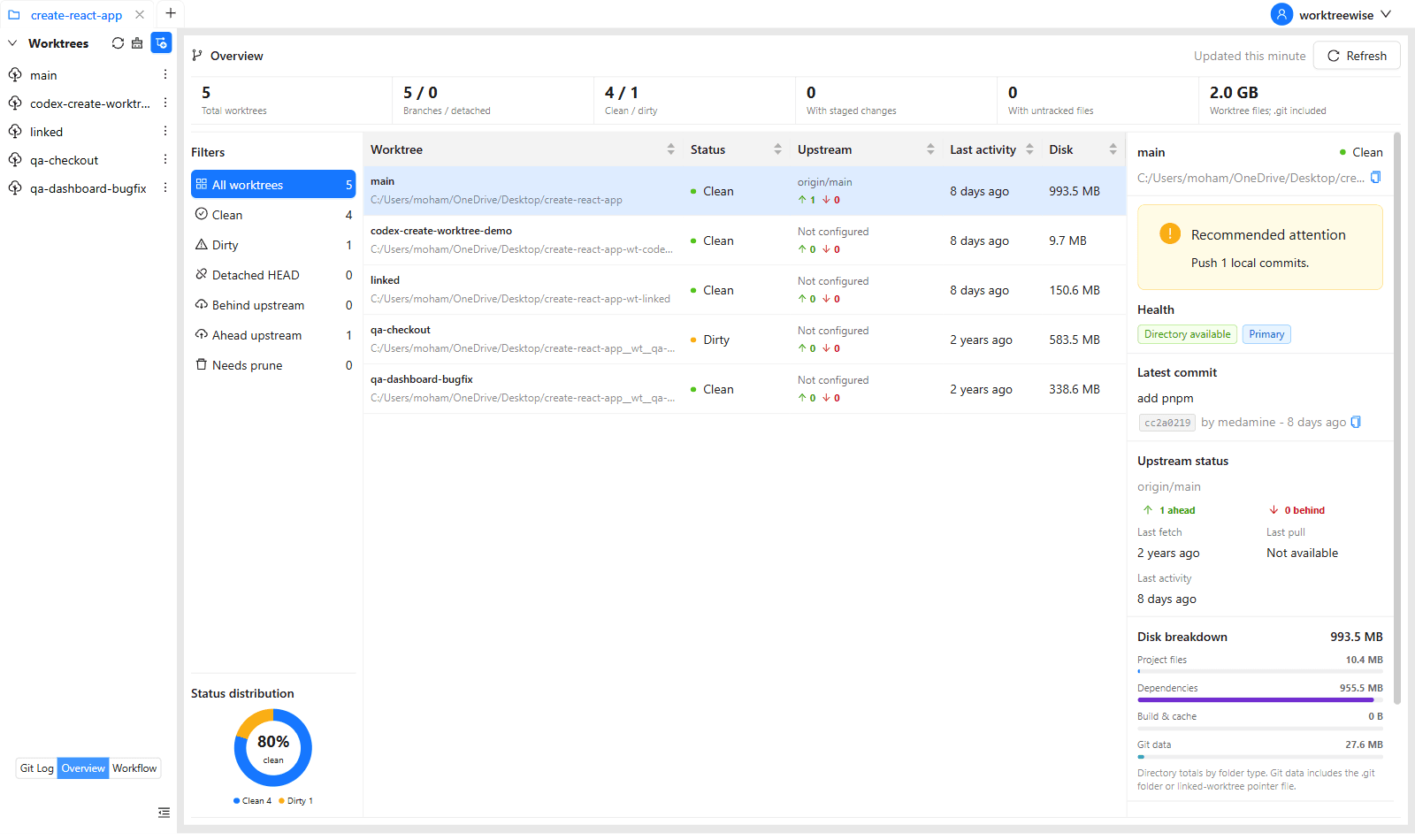
Summary Metrics Strip
At the top of the Overview dashboard, six live metric cards provide an immediate snapshot of your entire repository:
| Metric Card | What It Measures | Why It Matters |
|---|---|---|
| Total worktrees | Total count of all registered worktrees | Helps monitor active parallel working directories |
| Branches / detached | Count of branch-linked worktrees vs detached HEAD states | Identifies worktrees that may not be committing to a named branch |
| Clean / dirty | Worktrees with no uncommitted changes vs worktrees with modified files | Tells you immediately where unfinished work or uncommitted experiments reside |
| With staged changes | Worktrees having files prepared in the Git index | Prevents forgetting staged commits before switching tasks |
| With untracked files | Worktrees containing new unversioned files | Flags generated build artifacts or missing .gitignore rules |
| Disk consumption | Aggregate disk space across all worktrees | Includes project source files, dependencies (node_modules), build artifacts/caches, and .git data |
Status Distribution & Quick Filters
The left sidebar of the Overview provides intuitive filtering and visual health distribution:
Status Distribution Donut Chart
A color-coded donut chart visualizes the percentage of Clean versus Dirty worktrees in your repository. At a glance, you can verify whether your working branches are tidy or have uncommitted modifications.
Filter Buttons
Click any filter button to instantly narrow down the worktree table:
- All worktrees: Shows all primary and linked worktrees.
- Clean: Displays only worktrees with zero uncommitted modifications.
- Dirty: Displays only worktrees with modified, unstaged, or untracked changes.
- Detached HEAD: Surfaces worktrees not bound to a local branch reference.
- Behind upstream: Highlights branches that have fallen behind their remote-tracking counterpart and need a pull/rebase.
- Ahead upstream: Shows branches with local commits ready to be pushed to remote.
- Needs prune: Highlights stale worktrees whose directory was deleted or moved outside WorktreeWise.
Interactive Worktree Table
The center table displays sortable columns for rapid scanning:
- Worktree: Displays the worktree name and absolute file path. Click any row to view its details in the right-side Inspector panel.
- Status: Visual status badge:
- ● Clean: Working directory is clean.
- ● Dirty: Uncommitted modifications or untracked files exist.
- ● Attention: Merge conflicts or missing directory detected.
- Upstream: Shows the configured remote tracking branch, accompanied by green Ahead (↑) and red Behind (↓) commit counters.
- Last activity: Relative timestamp indicating when the worktree was last modified or committed to (e.g.
2 hours ago,3 days ago). - Disk: Total disk usage formatted in bytes (B, KB, MB, GB). If calculations are still running in the background, a
Calculating…indicator is shown.
Worktree Details Inspector Pane
Selecting any worktree in the table opens an in-depth Inspector pane on the right:
Header & Warnings
- Worktree Name & Path: Displays the full path with a one-click copy button.
- Recommended Attention Alert: Appears automatically if the worktree needs pruning, has merge conflicts, or is critically stale. Specific nudges guide you on what action to take.
Health Status Tags
- Directory:
available(green) ormissing(red). - Primary: Tagged with a blue
Primarybadge if this is the repository’s main worktree. - Locked: Indicates whether the worktree is protected from accidental deletion or renaming.
- Needs prune: Warns if Git metadata remains but the folder was removed.
- Stale: Identifies worktrees with no activity for extended periods.
Latest Commit Card
Displays the most recent commit on the worktree’s checked-out branch:
- Commit subject headline.
- 8-character commit hash with one-click copy.
- Author name and relative commit date.
Upstream Status & Divergence
- Full remote-tracking branch name (e.g.
origin/feature-login). - Divergence indicator showing exact ahead/behind commit counts.
- Last fetch: Timestamp of the most recent fetch from the remote.
- Last pull: Timestamp of the last successful pull operation.
- Last activity: Recency of working directory file alterations.
Granular Disk Breakdown
WorktreeWise breaks down the worktree’s storage footprint into four distinct categories, complete with visual progress bars:
- Project files: Source code and repository files tracked by Git.
- Dependencies: External package folders (e.g.
node_modules,vendor). - Build & cache: Compiler outputs, dist directories, and local caches (e.g.
.next,dist,build,.cache,target). - Git data: Git administrative files (
.gitfolder or linked-worktree gitdir pointer file).
Local Changes & Large Untracked Files
- Metrics grid showing exact counts of Modified, Unstaged, Staged, and Untracked files.
- Large Untracked Files Alert: Highlights unexpectedly large untracked files (e.g. accidentally downloaded datasets, database dumps, or media files) along with their exact sizes, helping you prevent accidental commits of massive files.