Workflows
Workflows in WorktreeWise provide a powerful automation engine to define, reuse, and execute ordered command sequences across one or multiple worktrees in Sequential or Parallel mode.
Whether you need to install dependencies across five branches, run test suites concurrently, or perform automated database migrations, Workflows eliminate repetitive terminal commands and provide real-time execution monitoring.
To access Workflows:
- Click Workflow at the bottom of the Worktrees sidebar.
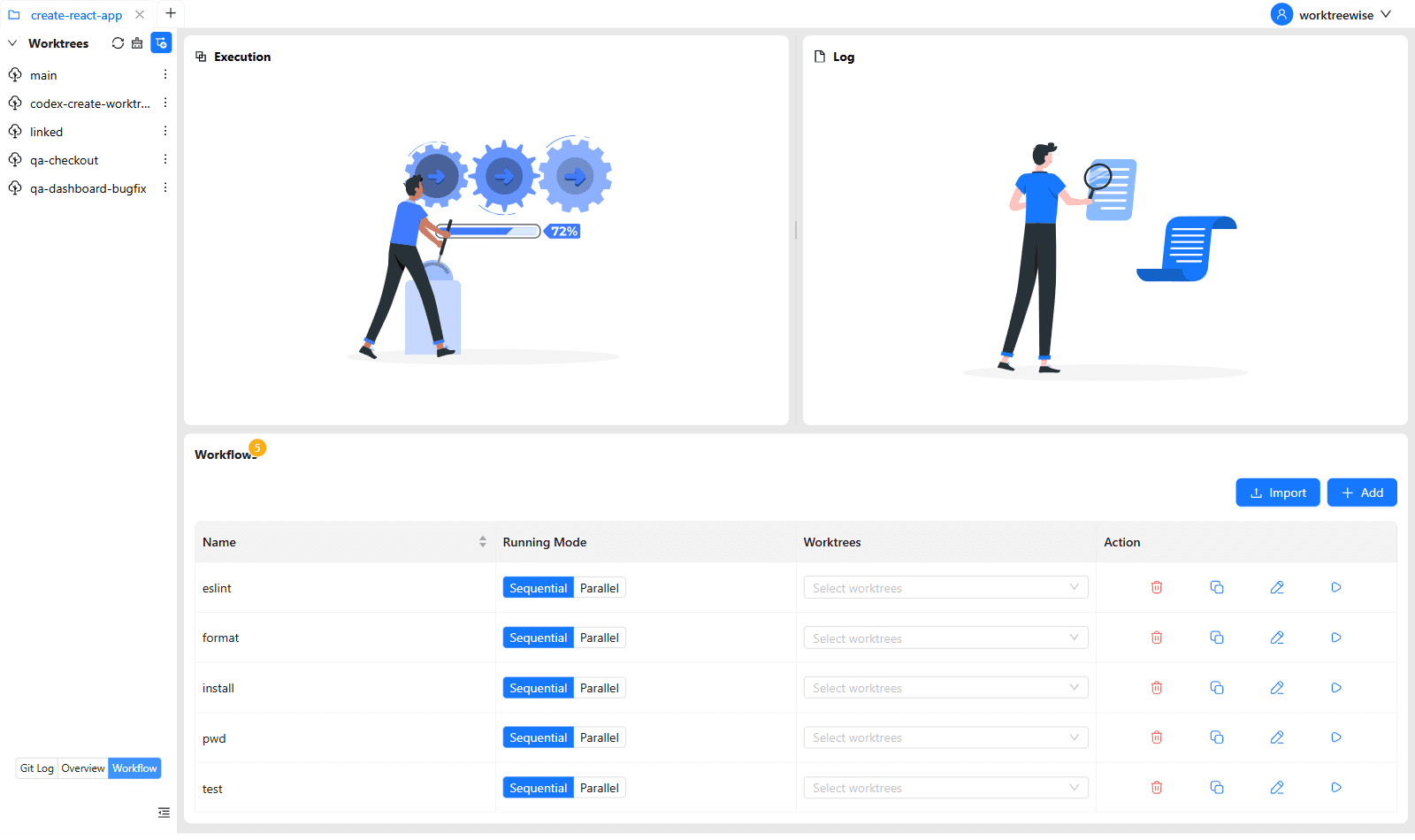
Workflow Workspace Architecture
The Workflows page is structured into three coordinated sections:
1. Saved Workflows Table
The table lists all workflow definitions saved for your repository:
- Workflow Name: Descriptive title (e.g.
Run Unit Tests & Lint,Full Build Matrix). - Commands: The ordered sequence of shell commands configured for this workflow.
- Execution Mode: Toggle between Sequential and Parallel execution.
- Target Worktrees: Multi-select dropdown to choose which worktrees this workflow will execute against.
- Actions Column:
- Play / Stop: Start or immediately cancel workflow execution.
- Edit (✏️): Open the slide-out drawer to adjust commands or rename the workflow.
- Duplicate: Clones the workflow to create a new variant without modifying the original.
- Delete (🗑️): Permanently removes the workflow definition (leaves worktrees untouched).
2. Live Log Streaming Panel
Below the table, the Log panel displays streaming terminal output as commands execute:
- Captures
stdoutandstderrin real time with ANSI color code support. - Displays execution status for each target worktree.
- Automatically highlights errors and exit codes if a step fails.
- Fullscreen Mode: Press Shift + F to expand the log panel to full screen; press Esc to exit.
3. Toolbar Actions
At the top of the workflow list:
- Add Workflow (
Shift + A): Opens the drawer to construct a new workflow step-by-step. - Import Workflow (
Shift + I): Imports previously exported workflow JSON files from disk.
Sequential vs. Parallel Execution
| Feature | Sequential Execution | Parallel Execution |
|---|---|---|
| How it runs | Executes the full command list in Worktree A, then moves to Worktree B, then C. | Spawns background worker processes simultaneously across all selected worktrees. |
| Best Used For | Tasks with shared resources: database migrations, seed scripts, shared cache warmups. | Independent tasks: linting, unit testing, formatting checks, typechecking. |
| Performance | Predictable CPU and memory footprint. | Maximum speed by utilizing multi-core processor concurrency. |
| Resource Safety | Guarantees no port collisions or concurrent file locks. | Requires worktrees to have isolated environments or independent configurations. |
Best Practices for Workflow Commands
- Non-Interactive Commands:
Ensure all commands run non-interactively without prompting for user confirmation (e.g., use
npm ciinstead ofnpm install, or pass-y/--yesflags). - Relative Paths:
Commands automatically execute with the selected worktree root as the current working directory (
cwd). Avoid hardcoded absolute paths likeC:\Users\...or/home/.... - Fail-Fast Chains: If a command in the chain fails (non-zero exit code), WorktreeWise halts execution for that worktree and logs the exact failure line.